

AUSTIN
_SPACE
This site gets exactly the same effort as any client project. Same platform, same constraints, same standard. If something here does not hold up, it does not get recommended.
Web design consultancy in Worcester. Built and maintained on Squarespace.
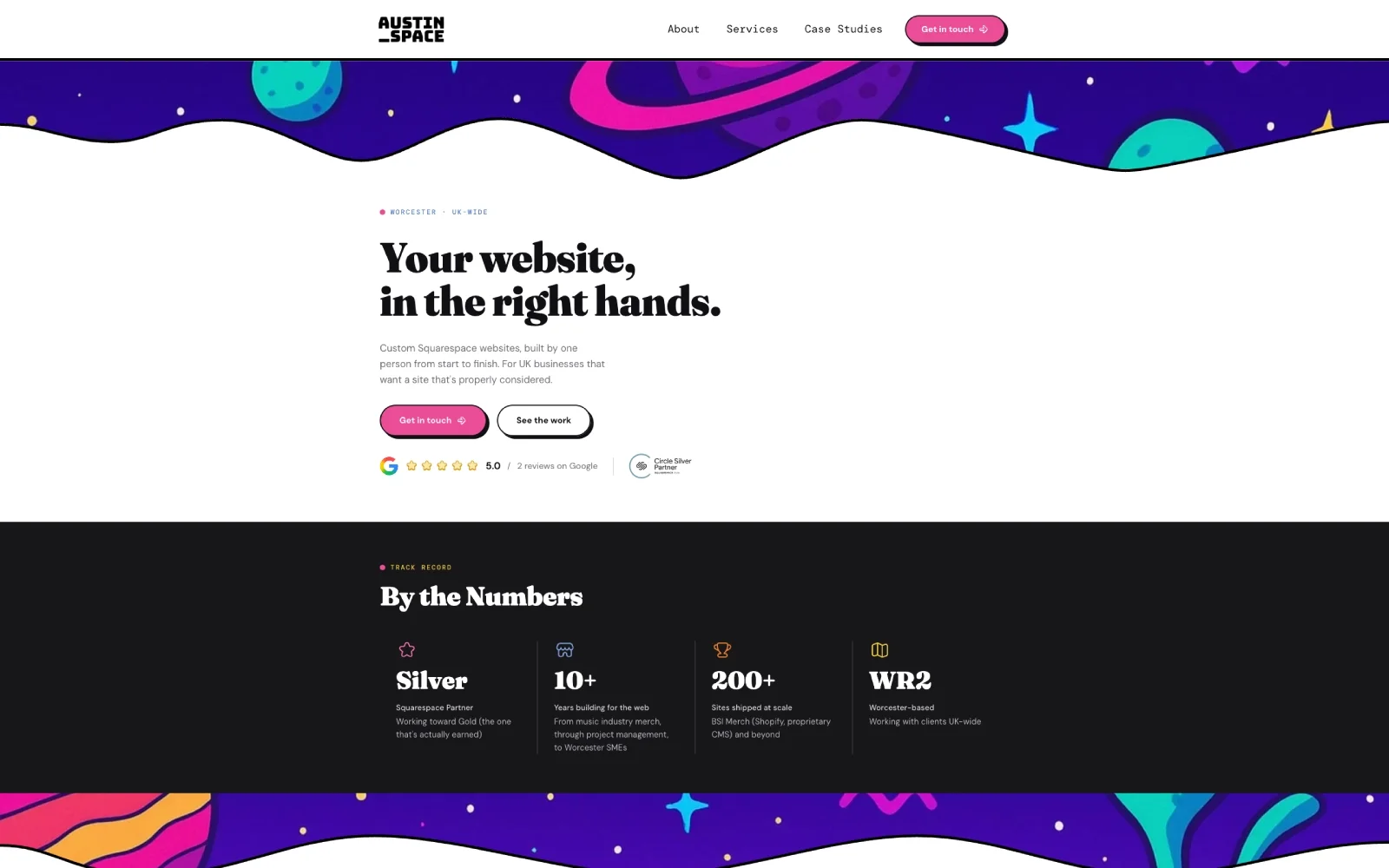
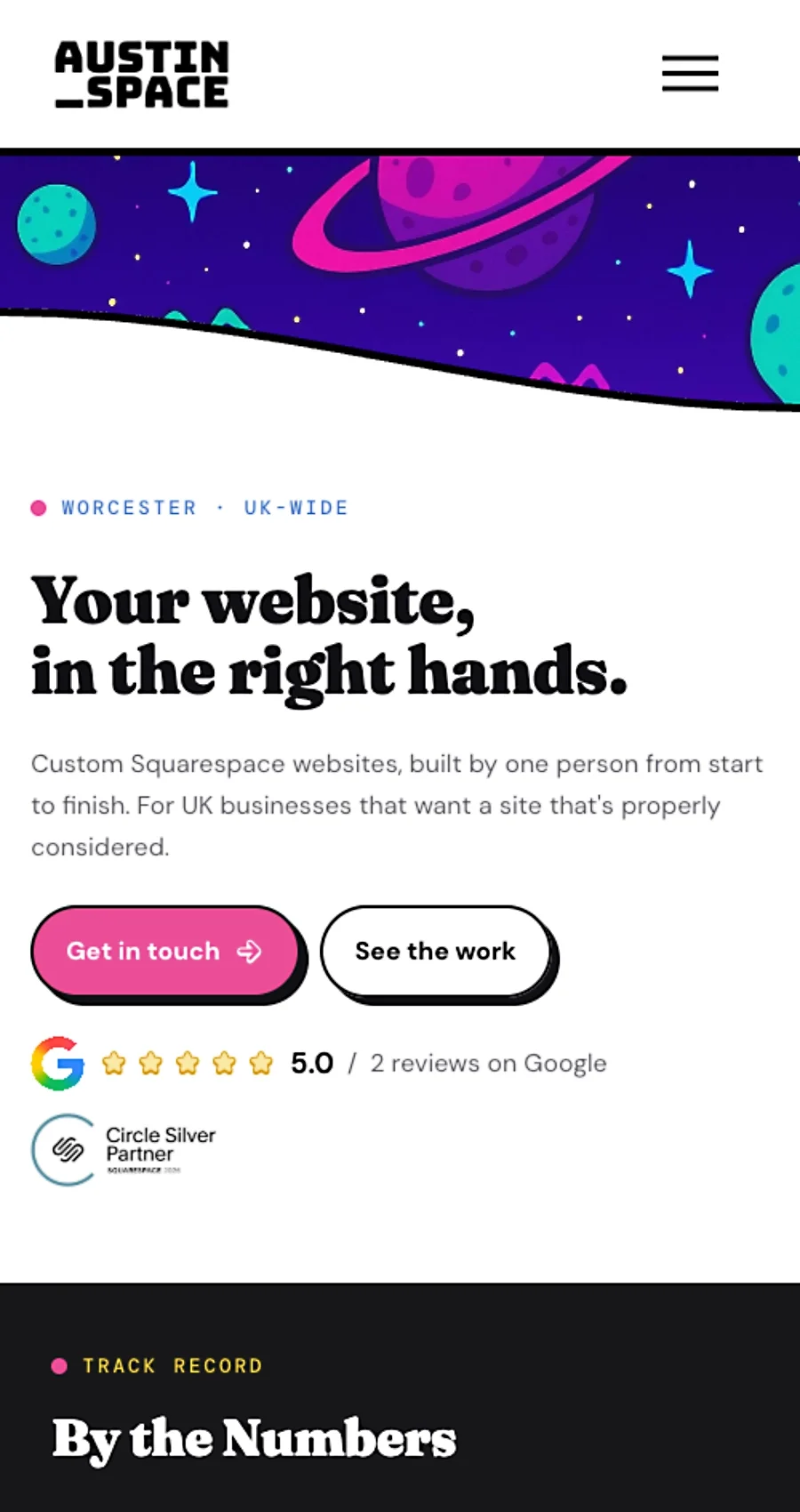
Things you can check yourself
Starting from nothing
AUSTIN_SPACE launched with no brand, no reputation, and nothing to point at. The site had to establish an identity, explain a service that competes directly with full agencies, and demonstrate the standard of work being sold. All three at once, and all inside Squarespace.
Building your own site is also the project that never gets prioritised. Client work comes first, which is the correct order but makes for slow progress on your own.
Position
- No existing brand or online reputation
- Solo consultancy competing against full service agencies
- The value of direct access is hard to show and easy to claim
- Logo, typography, colour and tone all needed creating at once
Platform constraints
- Squarespace strips inline style blocks from page code blocks
- No server side access, so every performance gain has to come from the front end
- Render blocking resources and legacy scripts are baked into the platform
- The custom CSS panel fails silently once the stylesheet gets large enough
Self imposed rules
- No template layouts, no plugins, and one native content block
- Nothing ships here that would not ship on a client site
- Every change verified on the live site, not assumed from the source
How it was actually built
A component system, not a set of pages
Squarespace does not give you a design system, so the first job was building one. Every visible element on this site belongs to a named component with its own namespace.
- Custom BEM namespace throughout, so no class can collide with Squarespace's own
- CSS custom properties for colour, spacing, radius, shadow and type, defined once and referenced everywhere
- Shared components across pages, so a change to a card or a call to action moves every instance at the same time
- All seventeen page headers share one structure, differing only by a modifier class
Note: the wave that separates each header from the page is a clip path, and the ink line that traces it is a separate SVG. Hand drawing the line to match the clip never quite works. It has to be derived from the clip's own path commands, or the two drift apart at certain screen widths.
The stylesheet problem
A single stylesheet is the right architecture on Squarespace. It also runs into a platform limit that gives you no warning at all.
- All styling lives in one master stylesheet in Design, Custom CSS. Page code blocks contain HTML only
- The authoring copy is heavily commented for maintainability, which pushes it past the panel's size limit
- A build script strips those comments to produce the deployed copy, so the readable version and the shipped version never diverge by hand
- Comments are ASCII only, because a single unusual character in a CSS comment will break the parser and silently kill the entire stylesheet
Note: past a certain size the custom CSS panel accepts a paste, shows the full text back to you, and saves only a fragment. Every custom rule disappears at once and the site looks catastrophically broken rather than unsaved. Knowing that failure mode, and how to confirm it from the browser's own resource timings, is the difference between a five minute fix and a lost afternoon.
Typography and payload
The site was loading eight typefaces. Some were being requested by Squarespace's own font settings rather than by any code, which is why removing them from the stylesheet had no effect.
- Reduced from eight typefaces to three, verified across every page
- Tracked down the remaining requests to Squarespace's own font assignments, which no amount of code editing would have fixed
- Rebuilt the type scale so headings use one fluid rule instead of six competing sizes
- Set a minimum body size across the site, and raised every form input to sixteen pixels so mobile browsers stop zooming on focus
Verify on the live site, every time
Nothing on this site is assumed to be working because the source says it should be. The source and the live page are two different things, and only one of them is what a visitor sees.
- Every change is checked against the live page after deployment, not against the local file
- Measurements are taken from the rendered page, because the platform's stylesheet cannot be read back programmatically
- Cache is cleared before measuring, since the CDN will happily serve the previous version and make a successful change look like a failed one
- This process has repeatedly caught changes that were reported as complete but had not reached the live site
Selected pages
Every page here is live. Open any of them and inspect it.
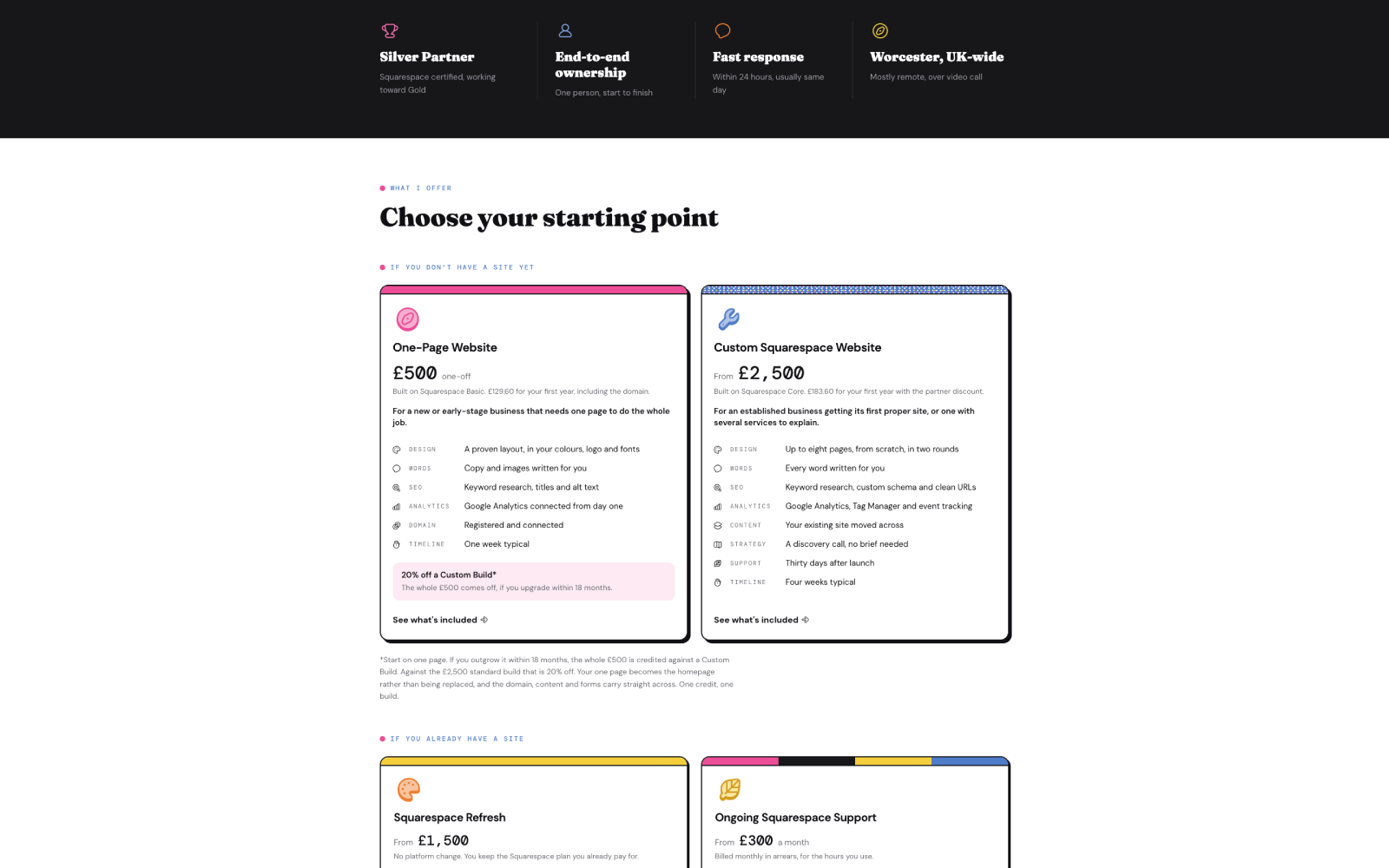
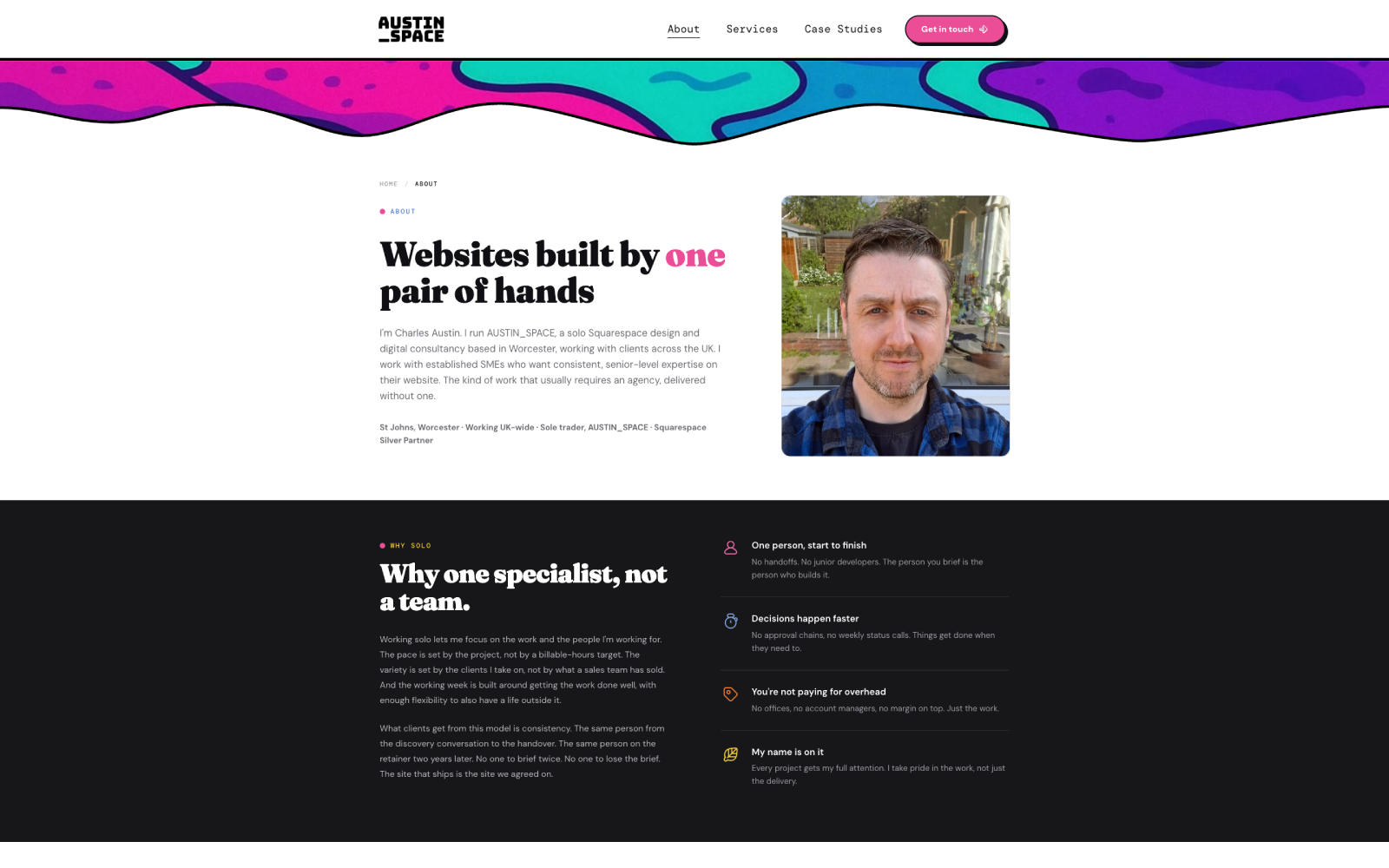
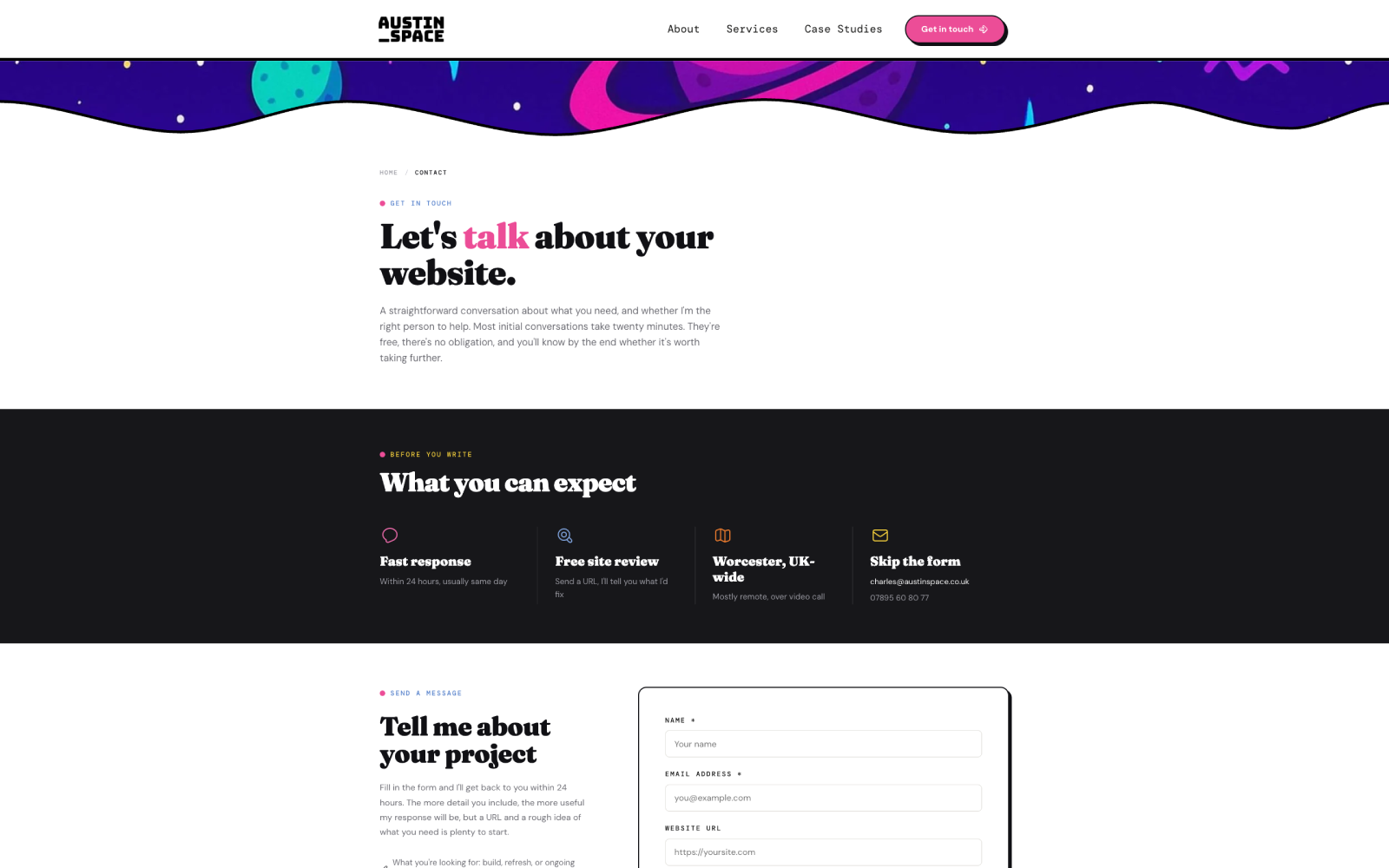
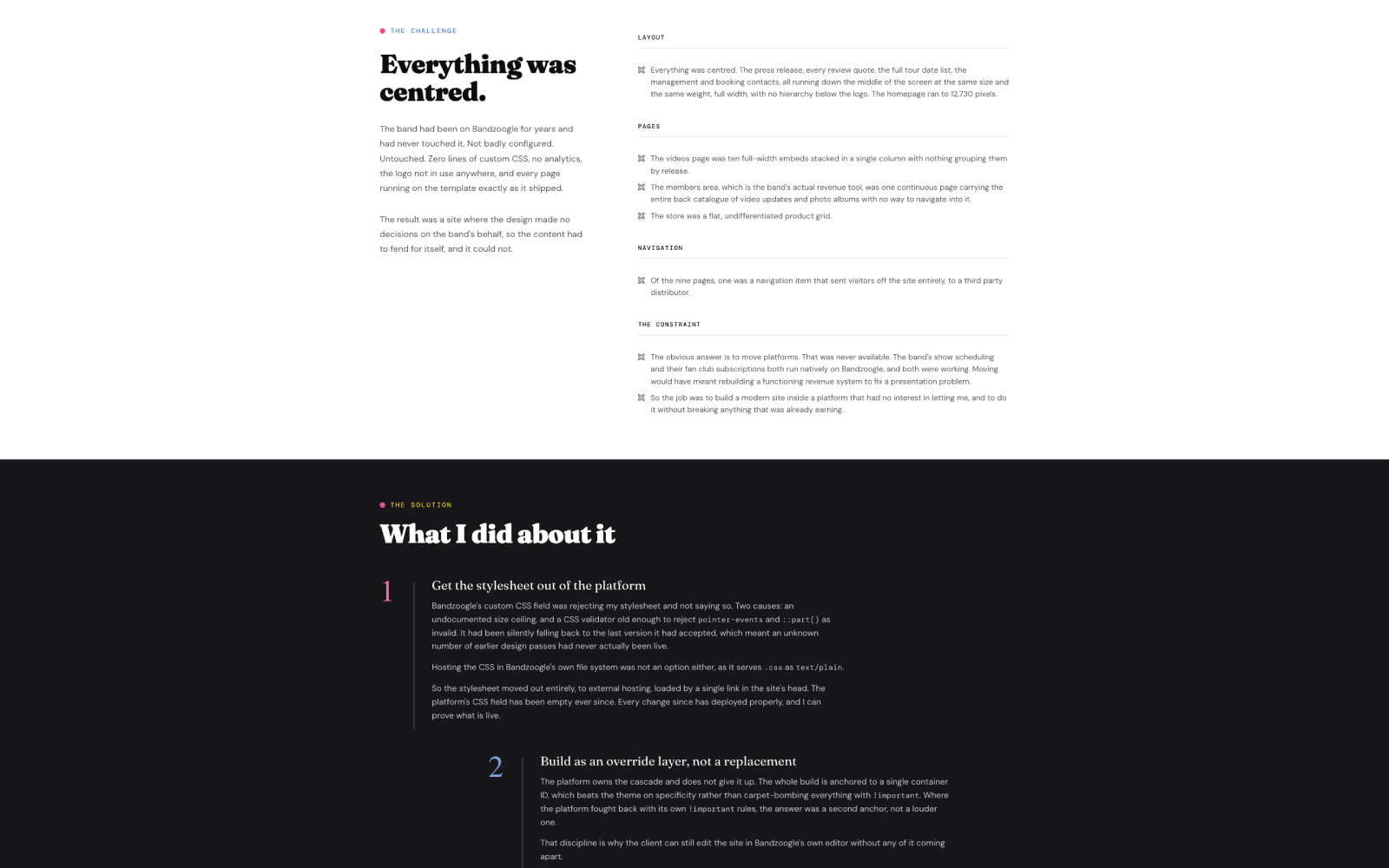
AUSTIN_SPACE home page
Common questions
Why build your own site on Squarespace?
Because it is the platform I specialise in, and a showcase built on a different stack would prove nothing. If I am going to tell you what Squarespace can do in the right hands, the honest way to demonstrate it is to be standing on it.
What makes this different from a standard Squarespace build?
Almost everything you can see is custom HTML and CSS rather than template layouts or native content blocks. The one exception is the contact form, which is a native Squarespace section. The design system, the component library, the analytics, the structured data and the performance work were all built from scratch inside the platform's constraints. You do not have to take my word for any of it. Open the inspector.
You are a web designer. Does your own site rank?
Not yet. The site is young, it has very few external links pointing at it, and Google allocates crawl attention according to how established a domain looks. Some of my own service pages have been found by Google and not yet fetched, which is normal for a new site and is fixed with links and time rather than with more keywords. Anyone selling you rankings on a brand new domain is selling you a timeline they do not control.
How was AI involved in this build?
Heavily, and openly. AI was used throughout for working through CSS architecture decisions, drafting and refining copy, generating schema markup, and interrogating my own assumptions before they shipped. It does not replace knowing what good looks like, but it is a tireless second opinion, and pretending otherwise would be dishonest about how the work actually gets done.
How long did this site take?
Longer than it should have, because client work comes first and always will. The visual direction came together early and then went through several iterations before it was worth publishing. If you are wondering whether your project would get the same treatment, it would get better: yours has a deadline and mine does not.
Can you do the same for my site?
Send me your URL and I will take a look. The first review is free. I will tell you where things stand, what I would fix first, and whether the work is worth doing at all. No obligation.
Want the same rigour applied to your site?
Every project starts with a conversation. Drop me a line and we'll talk through what you need.